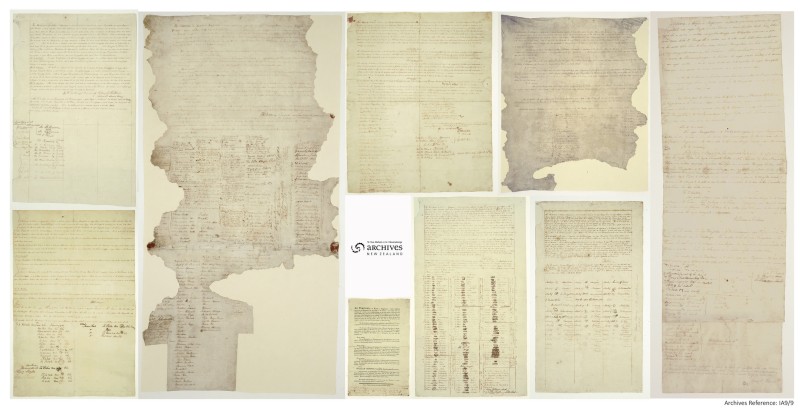
Archives NZ The Treaty of Waitangi. Te Tiriti O Waitangi. Waitangi Sheet. Reference IA 9/9. Sheets 1-9
New Zealand is an independent sovereign nation. Because it is a monarchy, New Zealand is called a "Realm."
The Realm of New Zealand comprises New Zealand, Tokelau, the Ross Dependency and the self-governing states of the Cook Islands and Niue.
As Head of State of New Zealand, King Charles' formal New Zealand title is: "Charles the Third, by the Grace of God, King of New Zealand and His Other Realms and Territories, Head of the Commonwealth, Defender of the Faith."
The Governor-General is the representative of the Head of State, Charles III, King of New Zealand. The office and powers of the Governor-General are set out in the Letters Patent Constituting the Office of Governor-General of New Zealand. The Letters Patent were completely revised in 1983 and amended in 1987 and 2006.
The King appoints the Governor-General, whose formal title is Governor-General and Commander-in-Chief in and over New Zealand, on the advice of New Zealand's Prime Minister, usually for a term of five years.
New Zealand's constitution is not found in one document. Instead, it has a number of sources, including crucial pieces of legislation, several legal documents, common law derived from court decisions as well as established constitutional practices known as conventions. Increasingly, New Zealand's constitution reflects the Treaty of Waitangi as a founding document of government in New Zealand.
The Constitution Act 1986 is a key formal statement of New Zealand's system of government, in particular the executive, legislature and the judiciary. The Act recognises the King as the Head of State of New Zealand and the Governor-General as his representative.
Other laws that outline the powers and functions of the three branches of government in more detail include the State Sector Act 1988, the Electoral Act 1993, the Judicature Act 1908 and the Senior Courts Act 2016 and the District Court Act 2016.
Other important legislation includes the Treaty of Waitangi Act 1975, Ombudsmen Act 1975, the Official Information Act 1982, the Public Finance Act 1989, the New Zealand Bill of Rights Act 1990, the Human Rights Act 1993.
Some British laws, such as parts of Magna Carta 1297 and The Bill of Rights 1688, and the Act of Settlement 1701 and the Royal Marriages Act 1772, have been incorporated into New Zealand law by the Imperial Laws Application Act 1988.